Worship at St Luke’s
We gather in worship to be shaped by encountering God, and then are sent out into the world.
Our Services
Come in, and rest a while – let God’s love enfold you.
Worship draws us into the mystery of God’s love, and forms us for all that we do in life. We have a range of regular weekly services, as well as special celebrations at sacred moments in the year, such as Christmas and Easter. A sermon is offered at both our Sunday morning services and a short reflection on Wednesdays. Our monthly contemplative service offers spaces for silent meditation.
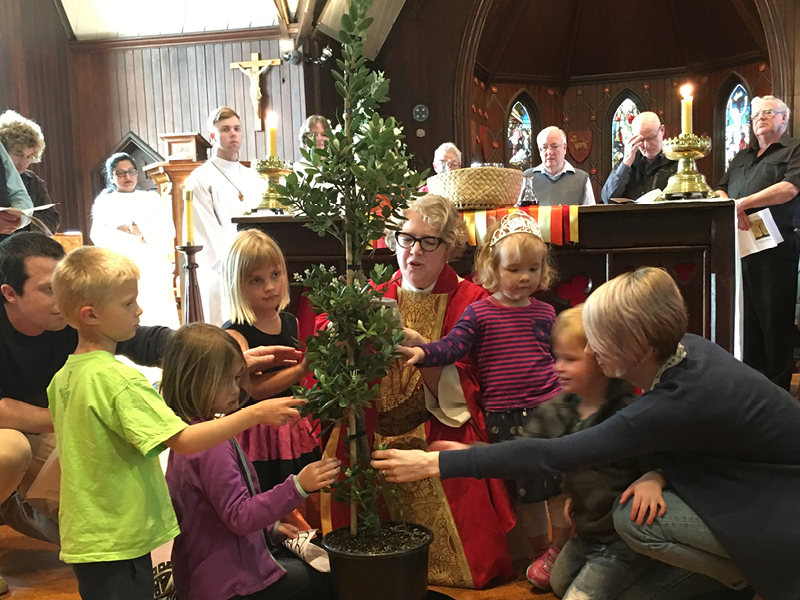
Sunday 9:30am Community Eucharist
Our main weekly service, this is a contemporary expression of the Anglican liturgical tradition.
The service involves prayers, readings, a sermon, and communion, with personal prayer and anointing if anyone wishes. Our children stay with us throughout the service and are supported and involved in our liturgy in various ways, because we want them to understand that church is their place too. We enjoy sermons that are thoughtful, challenging, and relevant to our daily lives as Christians in the contemporary world.
Coffee and tea are shared after the service as a natural extension of our gathering. This is an opportunity to catch up with one another as well as meet new people.

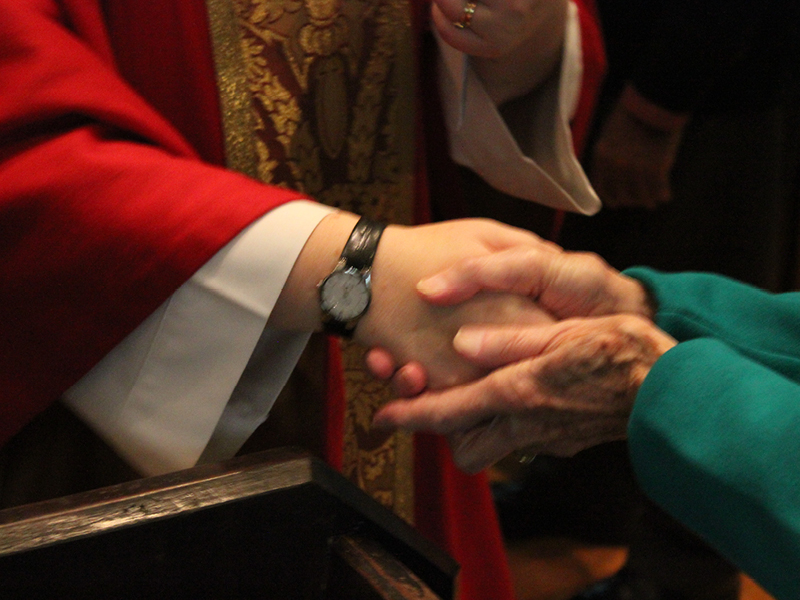
Wednesday 11am Eucharist
Like many Anglican communities, we have a small but happily committed group who gather for a midweek Eucharist. This is a lovely service, with moments of both reflective silence and laughter. Please contact Clare for details.
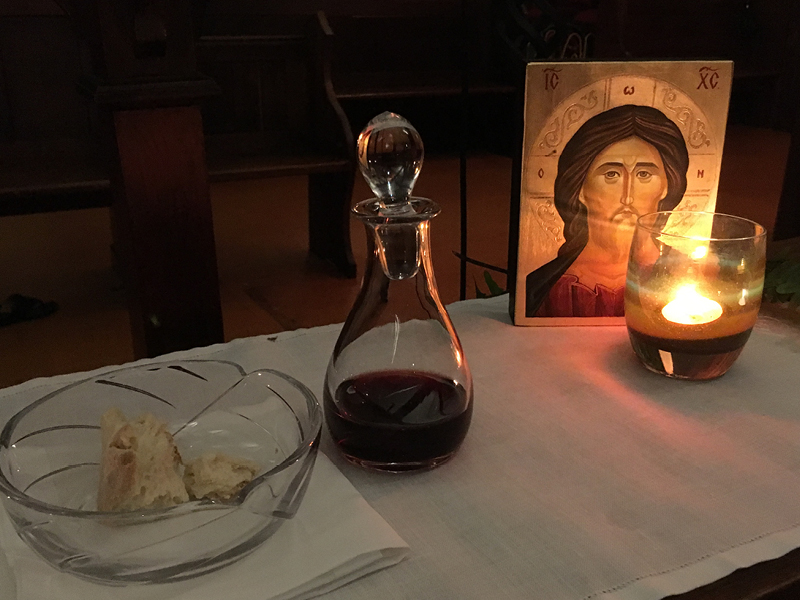
Breathing Space – Monthly Contemplative Eucharist
Held at 7:30pm on the first Sunday of the month, this is a deeply reflective and spacious experience of the eucharist, in which we take time to rest in God’s presence.
The liturgy is quite simple and people are invited to participate as much or as little as they feel comfortable with. There are some times of contemplative prayer, in the mode of guided silent meditation. We have a cup of tea afterwards for those who are keen to stay.
Please contact Clare if you’d like to be added to the monthly mailing list for a reminder.
Sunday Sermons
Hildegarde of Bingen (Creationtide 2 Year A)
This week the old oak trees here at St Luke’s have come out in their spring green. It is one of those imperceptible shifts that seems to arrive overnight every year – suddenly, astonishingly, everything is different. The whole place seems to have greened.
Creationtide 1 Year A
For all the ills of both the mainstream and social media, and they are manifold, there is an incredible connectedness and immediacy about it that brings the world close, and as we see almost daily on our news, our world, God’s creation, is suffering immensely, and consequently, so are we. Who hasn’t seen the terrifying videos of the massive flood pouring down through the valleys of Nepal over this past week?
Ordinary 22 Year A
As Moses was commanded in our first reading to take off his shoes because he was on holy ground, so do we lift of the burdens of the world and our lives, as we gather here today on holy ground. I runga i te īngoa o te Matua, o te Tama, o te Wairua Tapu. Āmine.
Peter says it absolutely cannot happen! Jesus can’t simply be allowed to die.
Ordinary 21 Year A
“Jesus said to them, ‘But who do you say that I am?’”
One wonders if there was a silence, the sound of crickets, as the disciples were confronted with this question.
And then the silence was broken by Simon Peter. In one of those extraordinary moments of clarity that seem to come to Peter amid all his later bumbles and failures, he says, “You are the Messiah – the Christ – the Son of the living God.”
Feast of the Transfiguration & Hiroshima Day Year A
This week the church calendar has us weaving together some very different threads, different themes that jar our senses.
One is the story of the Transfiguration, that very strange ‘time out of time’ moment when Jesus took three of his disciples and climbed a mountain to pray. And then – as if it were the most ordinary thing in the world when one sets off to say one’s prayers – Jesus’ face changed and his clothes became dazzling white, and Moses and Elijah, those giant figures of the Hebrew scriptures, appeared beside him.
Ordinary 18 Year A
Imagine the scene – a rambling crowd of thousands who had followed Jesus out to ‘a deserted place’ after he’d gone out seeking solitude.
Ordinary 17 Year A
The reading from Genesis offers themes of new beginnings and the rhythms of the Earth.
Genesis 8:22 promises that seedtime and harvest, cold and heat, and winter and summer will not cease.
Nor will the winter rising of the stars be a marker for the agricultural and seasonal calendar.
Being grateful for food is a sensation we will experience a little later after this morning, when we share the wonderful hot soup prepared.
Ordinary 16 Year A
Jacob is fleeing in fear from his brother Esau – he is alone, and hungry, and tired. He is in deep trouble. He has lied and stolen from his own family, partly because, as it turned out, his family is pretty screwed up. We’ve been following the great arc of Jacob’s generational story in Genesis over these past few weeks.
Ordinary 15 Year A
We arrive this morning carrying whole ecosystems within us.
We bring the weather of the week just passed: conversations still circling in our minds, work left unfinished, people we are worried about, decisions waiting to be made, and the many demands competing for our attention.
Ordinary 14 Year A
Quite a few years ago now I travelled to San Francisco and went to a Sunday service at an Episcopal church called St Gregory of Nyssa, in the Mission District. I was taking a liturgy course taught by the clergy of St Gregory’s, and I wanted to experience how they lived out their ideas in their parish.
Ordinary 13 Year A
What are we to make of this terrifying and mysterious story of the binding of Isaac—the Akedah or Binding, as it is called in Jewish tradition?
It is a story we would rather not hear, I think; a story we’d prefer to suppress and avoid, for all sorts of reasons: as parents, as a preacher, as people of faith who want God and the world to make sense. This horrifying story of a demanding God, of a son who carries the firewood for his own burnt offering, of a knife.
Ordinary 12 Year A
In today’s gospel we encounter Jesus at the point where his movement is gaining moment and followers. We might even say that it is the midway point of his ministry.
And interested people are becoming disciples.
Which is possibly why at this point we hear him to start to articulate with a little more force and clarity what it means to be one of his followers.
Ordinary 11 Year A
After our detours through the wonderful feasts of Pentecost and Trinity, we’re picking up the thread again of Matthew’s gospel. Introducing a new part of his story, Matthew writes,
“Then Jesus went about all the cities and villages, teaching in their synagogues, and proclaiming the good news of the kingdom, and curing every disease and every sickness.”
Trinity Sunday Year A
A lot of clergy dread preaching on Trinity Sunday because it’s so hard to get beyond limited analogies: the Trinity is like ice, water, and steam, and so forth. There are things in life that we find hard to understand — like quantum physics, or depreciation, or Year 11 maths. Maybe we should leave the Trinity in the same too-hard basket.
Pentecost Year A
Of all the ways Christians speak about God, the Holy Spirit is perhaps the most elusive and difficult to describe.
And perhaps trying too hard to “make sense of” the work of the Holy Spirit is where we fall into a trap. It can’t be made sense of – rather, we need to live into it, let it come to life within us, overflow us. And that is not necessarily a safe or comfortable thing to pray for. The first Pentecost was not calm or tidy or carefully controlled – it was noisy, overwhelming, disruptive, and full of passionate energy.
Easter 7 Year A
The story of the Ascension is one of those biblical stories that sits right on the edge of what we can imagine historically. Some scholars argue that it was added later by the early church.
But my concern today is less with the mechanics of what happened, and more with the meaning the story is trying to convey. Stories like this communicate theological truth through image and symbol as much as through historical narrative.
Easter 6 Year A
Like last Sunday, we are still dwelling in that long arc of Jesus’ farewell discourse in John’s gospel – we are eavesdropping on the Last Supper. Judas has already gone out into the night on his mission of betrayal. Soon, Jesus and his disciples will leave for an evening walk to Gethsemane. But for now, everyone is sitting around the table and listening, while Jesus talks with his followers about the life of faith they will live in the future, when he’s no longer with them.
Easter 5 Year A
John’s gospel is unique in giving us this long, intimate account of Jesus’ conversation with his followers, gathered for a final meal. It is a farewell scene – though the disciples don’t fully understand that yet. But they do sense that something is ending, and they are anxious, unsettled, unsure of what is coming next.
Easter 4 Year A
The words of Psalm 23, the Shepherd Psalm, are words that have settled deeply into most of our hearts over many years. And we’re all familiar with those gentle, sentimental images of Jesus as a shepherd, sitting peacefully with lambs gathered around him.
Easter 3 Year A
Many of you will know that in the Anglican church, we follow a three year series of readings, so, each set of readings comes around every three years. Sometimes when a familiar passage comes up, I look back to see what I said the last time I preached on it – where was my mind and heart? What was happening in our world?
The Great Easter Vigil & Easter Day Year A
We’ve been journeying towards this night for a long time. This is the Great Easter Vigil, the night for celebrating Christ’s resurrection. It is the night when we celebrate and proclaim the gift of new life and Christ’s promise that death will not be the end of us, and is not the end of human meaning and hope. It is the night when we renew our baptismal vows, as Christians have been doing at Easter time since the early centuries of the church.
Palm Sunday Year A
It is our tradition on Palm Sunday to hear the story of Jesus’ Passion. This day is a hinge between the journey of Lent and the more intense days of Holy Week. And it is also our custom not to preach a full sermon, but simply to let the story dwell in our hearts and minds.
Lent 5 Year A
There aren’t many more heart-wrenching moments in the gospels than this one when Mary, the grieving sister of Lazarus, goes out to meet Jesus and says to him, ‘If you had been here, my brother would not have died…’ If only you’d been here…
Lent 4 Year A
We all see the world through filters. Often without realising it, we ask questions like: What do I already believe? Does this new idea confirm what I already think? Does it fit within the frame I have already constructed?
Lent 3 Year A
A few years ago, a friend of mine went on an Ignatian retreat in the hills north of San Francisco. Ignatian spirituality – from the 16th century saint, Ignatius of Loyola – invites people to pray with scripture imaginatively – to enter a gospel scene as fully as possible, attending to what they see, hear, smell and feel. They have a tradition of making 7-day or 30-day guided silent retreats, structured around this practice.
Lent 2 Year A
“Now there was a Pharisee named Nicodemus, a leader of the Jews. . . and he came to Jesus by night.”
I admire Nicodemus… He’s an intelligent, well-educated, seeking man, a rabbi and a leader amongst his people. He’s clearly deeply faithful and searching for God, for answers, for a difference, a hope for the future.
Lent 1 Year A
We continue to live with the impact of the
extreme weather events, the terrible impact of floods and cyclones.
Homes red stickered, communities cut off and tragically loss of lives in slips and flood water.
As floodwater recedes and local government and national government respond with emergency packages, there is a call from environmental groups and academics for more money to be spent on planning ahead – as it costs so much more reacting to physical disasters than funding towards climate adaptation and planning for resilience.
Ordinary 6 Year A
We are still eavesdropping on the Sermon on the Mount, in which Jesus has already called ‘blessed’ whole swathes of society who would not usually have understood themselves as included in God’s blessing. Last week we heard Jesus make his disciples and other listeners a promise about their very being, their identity.… ‘You are the salt of the earth you are the light of the world.’ This is about promise and gift, not judgment.
Ordinary 5 Year A
Salt, and light. Hear these words, and know that this is what you are in the eyes of God.
Jesus isn’t saying, ‘You should be the salt of the earth and light of the world.’ Or, ‘you have to be…’ let alone, ‘You better be…’ Rather, he’s saying, you are – you already are. Even if you don’t know it. Even if maybe you once knew it, but have forgotten it. Even if you’re not sure you believe it.
Ordinary 33 Year C (Proper 28)
When I’m feeling stressed about the state of the world, asking the big questions, like “will the economy crash shortly after we’ve purchased a house?” and “how close are we now to total ecological collapse?” I will flop on my bed and think about writing in my journal or praying or taking a nap.
Ordinary 30 Year C (Proper 25)
It’s no accident that we find ourselves at the Temple, in the parable we’ve heard from Jesus this morning. On the grounds of the Temple in Jerusalem, you were always aware of who you were, of the worth of what you should sacrifice, of your status, of what you could expect from God.
Ordinary 32 Year C (Proper 27)
One of the things I’m sometimes asked to do as a priest is to go and say prayers of commendation with someone whose death is imminent – sometimes at home, or in a rest home, or in hospital or a hospice. Most often my experience of these prayers before death is that the dying person is not very aware – by then – of what’s happening around them. But I always pray anyway because we’re connected to this world by all our senses and some say that our hearing is one of the last to go.
Advent 4 Year A
If we listen between the lines to Matthew’s gospel, we can hear that Joseph’s situation was desperately painful. Betrothed by their families as teenagers, as was their custom, he and Mary still lived with their own parents but were legally bound to each other as if already married.
Advent 1 Year A
Like so many things in our liturgical tradition, the season of Advent reminds us of a deeper reality that should colour not only these few short weeks in December, but the whole of our living. We are now preparing for the celebration of Christmas, the miracle of God’s gift to humanity in the birth of Jesus. But we are also, now and always, preparing for and living for Jesus’ second coming and the redemption – the healing and completion – of all creation. That’s the deeper reality that Advent is pointing to. Isaiah offers us a vision of a mountain lifted high, drawing all nations, a place where justice is taught and peace is learnt, where weapons are beaten into tools for sustaining life.
Here is your God! (Advent 3A)
So as our Advent journey continues, I pray that each of us can let the questions of John the Baptist settle into our hearts, and prepare there a space for pondering our own lives, our deep assumptions about those Christ would have us welcome, and our need for the healing of our own blindness and deafness to those who are not like ourselves.
Be transformed! (Advent 2A)
Advent means learning to see the world differently, learning to see it as the prophets did – to pray for and believe in God coming among us and acting among us and through us in a new way. Advent is a time when each of us can learn something about being prophetic people.
The love that overflows (Proper 25C)
Over and over again, in scripture, we see Jesus seeking out the broken, the lost, those written off by religious law, those who are powerless, those who somehow, by some measure, aren’t good enough. This is how grace works, and this is the heart of the gospels – the overflowing, abundant love of God.
The earth is waste and void… (Proper 19C)
It is the ultimate breakdown of the covenant promise, forgetting the deep relatedness and interdependence of all humanity and all creation with each other and to the divine… living instead out of a practical worship of the self as the sole reference point of for one’s existence.
St Francis of Assisi (1226)
Can we learn to see creation – all created things – as our brother and our sister, now desperately in need of healing and care? Can we learn to understand ourselves as part of a great, living, interrelated whole? Can we fall in love with God’s creation, as Francis did, and treasure it?
St Michael & All Angels (Michaelmas)
The life of faith is not so much a matter of each of us getting into heaven after we die as it is about living fully and completely in response to the one who is the source of life itself.
Creation Our Sister (Proper 18C)
It is beyond time that we learnt to give our sister, our mother, the place of honour so that we can all have a place at God’s banquet – the abundance of life in all of creation.
We the baptised… (Proper 15C)
“I’ve come to bring fire to the earth, and how I wish it were already kindled! I have a baptism with which to be baptised, and what stress I’m under until it is completed…”
Stay awake! (Proper 14C)
I don’t know if you have that problem of being caught by those marketing or survey phone calls where the phone rings right around dinner time. With younger kids and rushing to get dinner ready, I confess I’m not very Christian towards the marketers in particular [nope, this is a terrible time – click!].
It’s not about the money…(Proper 13C)
Here’s the thing about this parable about the bigger barn and the bigger harvest and the bigger fortune. It’s not about the money.
Christ walks our streets too (Social Services)
Thank you for the warmth of your welcome this morning – it’s good to be here again with you, our friends and neighbours. As Anglicans and Methodists we have much in common, and it feels deeply joyful to be together in worship and in shared hospitality.
Our old friends, Mary and Martha (Proper 11C)
We’re encountering two old friends this week – the sisters, Mary and Martha. We know them well. We’ve visited their home many times over the years, and pondered the complexities of Martha’s hospitality and Mary’s listening heart, dwelling in the loving regard of Jesus.
Send us a message - we'd love to hear from you!
Contact Details
St Luke’s Anglican Church
704 New North Road
Mt Albert 1022
Auckland, New Zealand
Ph: +64 9 846 6046
Office Hours: Mon: 2-4pm, Tues: 9.30-3pm,
Wed & Thurs: 2-5.30pm, Fri: 9.30-3pm
Sat, Sun & Public Holidays: Closed
Vicar: The Rev’d Dr. Clare Barrie
Administrator: AnnCharlotte Arul
Make a Donation
St Luke’s is part of the Diocese of Auckland, a registered charity. If you’d like a donation receipt for tax purposes please drop us a note with your details. Your support is greatly appreciated.
Contact Details
St Luke’s Anglican Church
704 New North Road
Mt Albert 1022
Auckland, New Zealand
Ph: +64 9 846 6046
Office Hours: Mon: 2-4pm, Tues: 9.30-3pm,
Wed & Thurs: 2-5.30pm, Fri: 9.30-3pm
Sat, Sun & Public Holidays: Closed
Vicar: The Rev’d Dr. Clare Barrie
Administrator: AnnCharlotte Arul